



Hit Odds Across 10-Pick Keno Cards
As you select more numbers on a Keno grid, the probability of catching higher matches drops exponentially. While catching 3, 4, or 5 numbers happens regularly during a standard playing run, moving beyond 5 matches requires extreme variance:
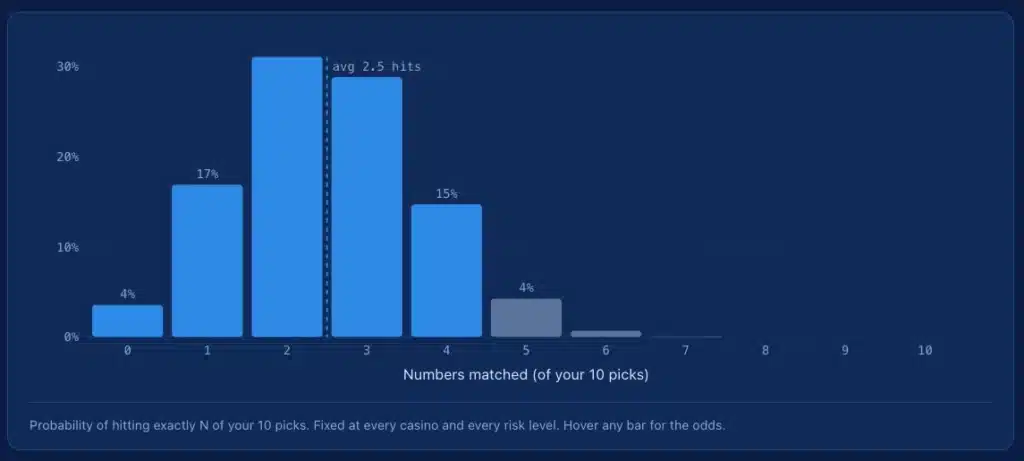
- 5 Matches: 5.14% probability (hits roughly 1 in 19 rounds).
- 6 Matches: 0.86% probability (hits roughly 1 in 116 rounds).
- 7 Matches: 0.08% probability (hits roughly 1 in 1,211 rounds).
- 8 Matches: 0.0023% probability (hits roughly 1 in 42,647 rounds).
- 9 Matches: 0.00012% probability (hits roughly 1 in 847,661 rounds).
- 10 Matches: 0.0000001% probability (hits roughly 1 in 847,660,528 rounds).
Where Your Keno RTP Actually Comes From (0 to 5 Matches)
Because matching 8 to 10 numbers is so rare, those top tier outcomes contribute almost nothing to the overall return of the game. Whether you play on Stake, BC.Game, or Roobet, the core return engine lives entirely at the bottom of the card.
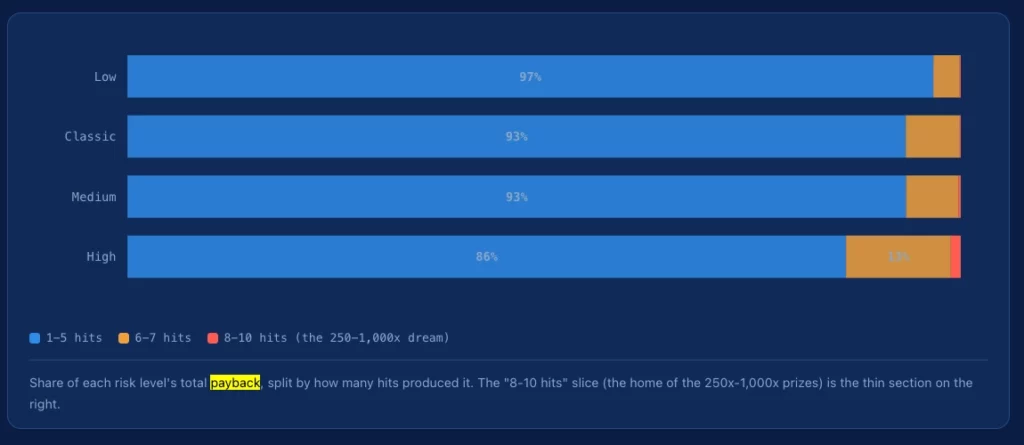
When you break down a typical 99% RTP Keno paytable by hit contribution, the distribution becomes clear:
| Match Range | Occurrence Frequency | RTP Contribution | Strategic Significance |
|---|---|---|---|
| 0 to 5 Matches | 99.85% of all rounds | ~99.1% of Total RTP | The core engine funding your play balance |
| 6 to 7 Matches | 0.14% of all rounds | ~0.8% of Total RTP | Occasional mid-tier balance boosts |
| 8 to 10 Matches | 0.0024% of all rounds | Less than 0.1% of Total RTP | Statistical variance background noise |
In fact, if an operator set the payout for 8, 9, and 10 hits to $0, the overall house edge would barely move. The headline jackpot is there to offer high-multiplier upside, but it is not what keeps your session going.
Comparing Fair Odds Against Real Keno Payouts
Another reason not to play solely for top jackpots is how casinos construct their high-risk paytables. As match difficulty increases, the gap between true mathematical odds and actual multiplier payouts widens drastically:
| Match Tier | True Fair Odds | Standard High-Risk Payout | Payout Haircut vs. True Odds |
|---|---|---|---|
| 4 Matches | 12.5x | 3.5x | -72% standard house margin adjustment |
| 6 Matches | 871x | 150x | -82% margin adjustment |
| 8 Matches | 43,478x | 250x | -99.4% payout compression |
| 10 Matches | 847,000,000x | 1,000x | -99.9999% extreme compression |
On routine 4 and 6 matches, payouts carry a standard house margin adjustment. For ultra-rare 8 and 10 match events, payouts are heavily compressed relative to their raw mathematical odds. You are taking on multi-million-to-one odds for a multiplier that pays more like a solid bonus round.
3 Practical Ways to Improve Your Keno Setup
Instead of chasing long-shot 10-pick jackpots, here is how you can optimize your Keno sessions for smoother bankroll control:
- Focus on 3 to 5 Pick Cards: Selecting 3 to 5 numbers aligns your targets directly with the achievable portion of the probability curve, giving you much higher hit frequencies.
- Evaluate Mid-Tier Multipliers First: When comparing Keno boards across operators, look closely at 3, 4, and 5-hit payouts rather than the top jackpot. Strong mid-tier payouts give your balance much better support.
- Match Risk Modes to Your Goals: If you want steady play time, Classic or Low Risk modes raise base payouts on lower match counts. High Risk mode is best reserved for quick, high-volatility sessions where you accept faster balance swings.
Want to inspect exact payback distributions across every pick count? Explore our full interactive data study: Keno: The Hidden Risk Dial.






Login
Register