



Standard 99% Boards vs. Duel’s 100% Model
To deliver a 0% house edge without breaking platform liquidity, operators must carefully balance payout distribution across the entire board. Comparing a standard 16-row high-risk setup on platforms like Stake or BC.Game against Duel reveals subtle yet critical paytable shifts:
| Feature Dimension | Standard 99% Plinko (Stake / BC.Game) | Duel’s 100% RTP Plinko Setup |
|---|---|---|
| Baseline House Edge | 1.0% built into base paytable | 0.0% mathematical edge (100% RTP) |
| Center Bucket Payouts | 0.2x drip-feed (65.6% drop frequency) | Slightly adjusted mid-tier weightings |
| Reward Mechanics | Rakeback tier unlocks and VIP level-ups | Instant rakeback and raw zero-margin structure |
| Session Volatility Feel | Steady balance erosion with occasional spikes | Pure statistical variance with zero safety buffer |
The core takeaway from the data is straightforward. On a standard 99% board, the house takes a small 1% haircut on every single drop. On Duel, that 1% drag is removed, meaning every fraction of a percent in return is delivered directly back to the player base through board payouts.
The Math of Zero-Edge Session Survival
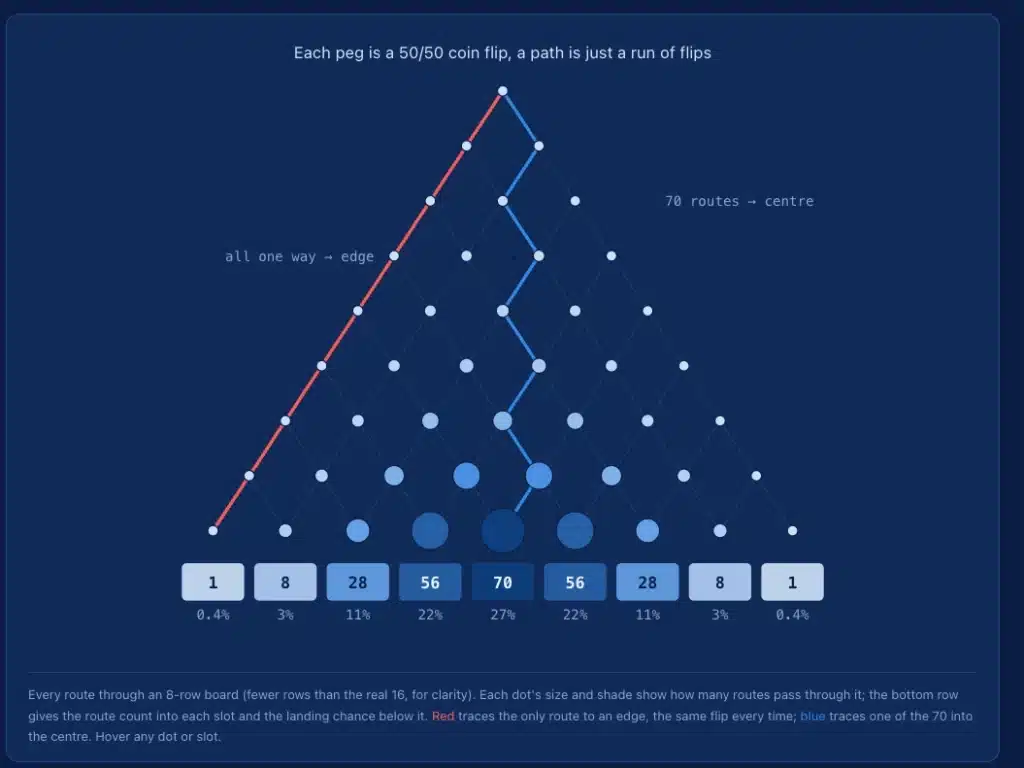
Removing the house edge does not remove binomial probability. On a 16-row Plinko grid, a dropped chip encounters 16 individual peg collisions before reaching a landing slot. This creates 65,536 unique operational paths, forcing over 80% of all drops into the central 0.2x, 0.5x, and 2x buckets.
The Zero-Edge Volatility Reality:
A 100% RTP board guarantees that across tens of millions of drops, total payout equals total wagered volume. Over a 500-drop individual player session, however, binomial concentration means your balance can easily swing down 40% before ever hitting an outer 26x, 130x, or 1,000x bucket.
When you drop balls at high auto-play speeds on a zero-edge board, you eliminate platform friction, but you accelerate your exposure to pure statistical distribution. If a bad variance streak hits early in your session, the absence of a house edge will not prevent a fast drawdown if your unit bet sizing is too aggressive.
Navigating Duel’s Board Mechanics in Practice
Capitalizing on a 100% RTP environment requires treating zero-edge Plinko as a high-volatility environment rather than a safe haven. Because the platform takes no edge, your return relies entirely on surviving the natural statistical swings required to reach high-value outer pegs.
Sizing your unit wagers to handle extended central bucket cold runs is essential. Lowering your bet size relative to your total session balance gives you the operational runway needed to absorb 50 to 100 consecutive low-multiplier drops. By combining small unit sizing with Duel’s zero-friction paytable, you let the math work in your favor without risking early session exhaustion before positive variance lands.
Want to inspect full board distributions and test simulated Plinko runs? Explore our full interactive study: BTCGOSU Plinko Data Study.






Login
Register