



The Rules of the Test Drive
To match the parameters from the original breakdown, we applied the exact ruleset across every trial limbo session:
- Target Multiplier: Fixed strictly at 9.00x (carrying an 11% hit rate per roll).
- Base Bet: Set at roughly 4% of the starting balance (1/25th of capital).
- Press on Wins: Double your wager every time a 9x hit lands.
- Two-Attempt Buffer: Allow up to two shots at any new personal-best bet size. If both miss, cut the bet in half and step back down.
- Target Exit: Attempt to cash out the moment the session balance reaches 10x its starting size, or play until the balance hits zero.
Phase 1: The Fast Burn of Opening Runs
The first reality you encounter with this system is session speed. On a 9.00x target, roughly 89% of individual bets end in a miss. Combined with a relatively aggressive base bet of 4% per roll, an early cold streak clears out a starting balance in short order.
In our initial 20 test sessions, 18 ended in a total loss within the first minute. A typical session involves launching the sequence, missing five or six rolls in a row, landing a single 9x hit to stay afloat, and then missing the subsequent doubled wager. Before you have time to settle into the session, the balance is spent.
This rapid drawdown is not a breakdown of the strategy—it is built into the design. The system does not aim for steady, incremental returns; it accepts high session turnover in exchange for concentrated upside when momentum aligns.
Phase 2: When the Engine Catches Traction
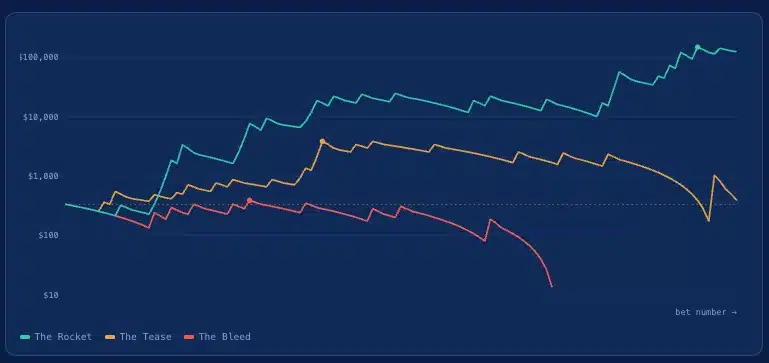
Around Run #34, the progression sequence finally found a foothold. Starting with a $100 test bankroll and a $4 base wager, we landed an initial 9x hit ($36 win). Following the rules, the next bet immediately doubled to $8.
The following roll hit 9x again, stepping the bet size up to $16, then $32. Within a short sequence of rolls, a balance that was hovering near drawdown climbed past $400. This highlights the structure of positive progression: by increasing bet sizes only after winning rounds, you are compounding gains from successful rolls rather than increasing exposure during a losing streak.
The Risk Profile:
While climbing the ladder provides a sharp upward curve, it carries equal downside volatility. Because higher tier bets represent significant portions of your current balance, two consecutive misses at a new peak will erase the majority of your accumulated gains just as quickly as they were generated.
The 100-Run Scorecard
After completing all 100 test sessions, our hands-on results aligned closely with large-scale statistical expectations:
| Session Outcome | 100-Run Count | Share of Total | Average Duration |
|---|---|---|---|
| Early Busts (< 2 Minutes) | 74 Sessions | 74% | ~45 Seconds |
| Mid-Range Peak (Hit 2x–5x) | 19 Sessions | 19% | ~2.5 Minutes |
| Successful 10x Cash-Outs | 7 Sessions | 7% | ~3.5 Minutes |
Out of 100 total attempts, 7 sessions reached the 10x target threshold and successfully locked in a cash-out. The remaining 93 sessions ended in a full loss of the starting test capital.
The Takeaway: High Volatility, Standard House Edge
Gamblito’s system offers an interesting alternative to standard flat-betting or negative progression models. By pressing wins and stepping back on losses, it shifts the gameplay experience into short, high-volatility bursts where win chains yield notable balance spikes.
However, the strategy does not alter the underlying 1% house edge. It simply trades frequent small session losses for the occasional significant payout run. For players looking to test the setup, setting a strict bankroll limit and sticking to a predetermined exit target remain essential.
Want to see what happens when this strategy is simulated across 2.6 million runs? Read our full empirical study: The $334 to $200,000 Limbo Run, Decoded. And see Gamblito22’s original post.






Login
Register