



The Gambler’s Fallacy: Why Martingale Fails on Dice
The core psychological trap of the Martingale system relies on a flaw in human perception known as the Gambler’s Fallacy.
If you flip a coin and it lands on red five times in a row, your brain frantically signals that black is due. You feel an overwhelming urge to double down, believing the odds of a sixth consecutive red are microscopic.
| Roll | Bet Size | Outcome | Cumulative Loss | Profit on Win |
|---|---|---|---|---|
| Roll 1 | $1 | Loss | -$1 | +$1 |
| Roll 3 | $4 | Loss | -$7 | +$1 |
| Roll 5 | $16 | Loss | -$31 | +$1 |
| Roll 7 | $64 | Loss | -$127 | +$1 |
| Roll 9 | $256 | Bust | -$511 | +$1 (if won) |
Mathematically, the memoryless nature of RNG means every single roll is independent. The game does not know you lost four times in a row, so the probability of losing the next roll remains identical.
Doubling bets creates exponential growth. Risking $256 on your 9th bet to secure a $1 profit is a massive imbalance of risk versus reward.
What 20,000 Simulated Sessions Reveal About Bust Rates
When players run a 50/50 “Coin Flip” setup with flat bets, session survival stays relatively stable over 1,000 bets. The moment you introduce doubling or aggressive recovery chasing, session survival collapses.
Even with flat $10 bets on a $500 bankroll (which allows 50 bets before running dry without wins), session bust rates on 50/50 setups range from 11.6% at low-edge casinos up to 26.9% at high-edge platforms.
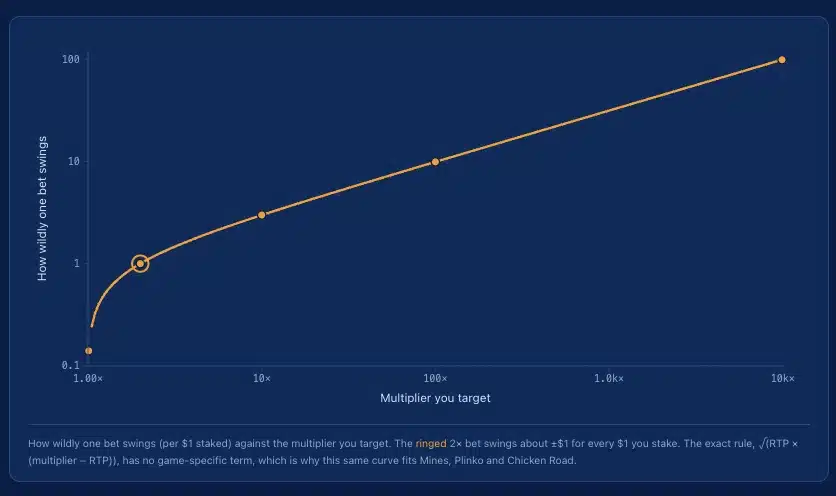
Over a standard 1,000-roll session, hitting an 8-to-10 loss streak occurs naturally within that volatility curve.
Table Limits: The Casino’s Anti-Martingale Shield
Even if you had an unlimited bankroll, say $1,000,000 in Bitcoin, the Martingale system still fails due to maximum bet limits built into every crypto casino.
Casinos remain protected from Martingale players for two primary reasons:
- The player eventually suffers a streak long enough to wipe out their balance.
- Players with deep pockets hit the table’s maximum wager limit before recovering their streak.
Once you hit the max bet cap, you can no longer double to recover accumulated losses. The chain breaks, leaving the bankroll with an unrecoverable loss.
3 Safe Rules for Managing Your Dice Bankroll
Understanding progressive risk changes how you should run your Dice sessions:
- Abandon Doubling Systems for Long Sessions: Progressive recovery strategies produce small wins most of the time, punctuated by complete bankroll wipeouts when a long streak hits.
- Understand Session Volatility: To make a bankroll last, keep individual bet sizes under 1% to 2% of your total balance.
- Choose the Right Platform: For high-frequency 50/50 bets, play at platforms with a 0% to 0.5% house edge like Duelbits or Gamdom. On 20,000 simulated sessions, casino choice alone accounted for a 15%+ difference in session survival rate.
Want to simulate your own Dice strategies across 20,000 real-world sessions? Check out the full BTCGOSU Dice Data Study.






Login
Register