



Ask any crypto gambler why they play Mines instead of a traditional slot machine, and you’ll usually get the same answer: control.
The Non-Game Zone: How High Mine Counts Trigger Instant Busts
Imagine sitting down at a table, placing a bet, and having the dealer immediately rake away your chips before you’re even dealt a card or given a turn to act. You’d walk away from the table.
Yet, that is precisely what happens to thousands of Mines players every single day.
When players scale up the risk dial, setting the board to 10, 13, or 15 mines to chase those enticing payout multipliers, they enter what we call the “Non-Game” zone.
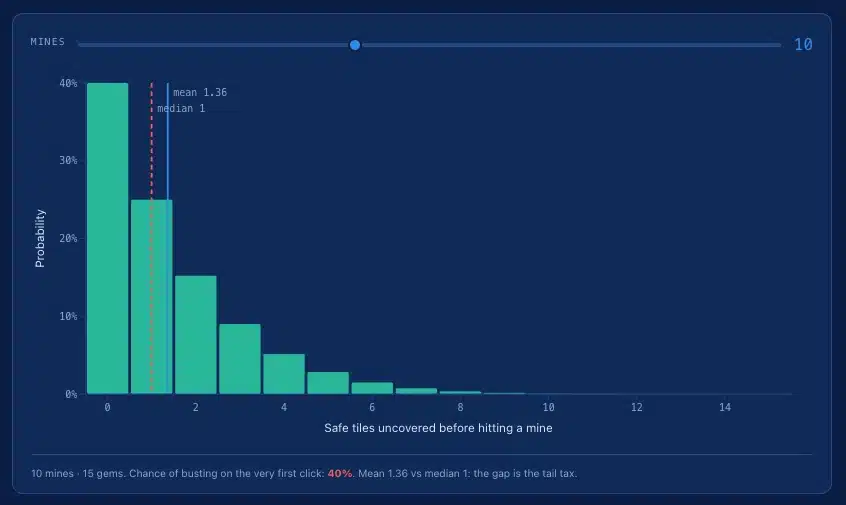
Notice that first bar on the left at 0 safe tiles? That’s a 40% probability of instant death on tile #1 (marked by the dashed red median line). Now push it to 13 mines or higher. The median survival rate instantly collapses to zero.
At 13+ mines, more than half of all rounds end on the very first click. You clicked a single square, hit a mine, lost your stake, and the round ended.
There was no strategy, no tension, no choice, and no “game.” You simply bought a heavily tax-laden 50/50 coin flip disguised as an interactive grid.
The Math Behind the “Tail Tax” (Averages vs. Medians)
If high mine counts result in repeated instant death, why do players keep setting the board to 10+ mines?
Because the human brain is notoriously bad at processing the difference between Averages (Means) and Typical Outcomes (Medians).
When you look at the theoretical average run for 10 mines, the math says you will uncover 1.36 safe tiles before busting. A player sees “1.36” and thinks: “Great! On average, I can click at least 1 tile safely, cash out, or try for a 2nd tile.”
But that 1.36 average is a lie driven by a statistical phenomenon known as the Tail Tax:
- The Reality: 40% of your rounds end instantly on click #1.
- The Illusion: A rare, lucky run that reaches 5 or 6 clicks pulls the average up to 1.36, hiding the fact that your median outcome was a dead stop on click one.
Players remember the thrilling 5-click run that paid out big, but their bankroll gets quietly incinerated by the 40% instant-bust tax required to pay for those rare tail events.
3 Mines Strategy Rules to Avoid the 1-Click Trap
The house edge in Mines is fixed (usually 1% on top-tier platforms). Math dictates that you cannot beat that edge in the long run.
However, you can control whether you are actually playing an interactive game or just throwing chips into an instant-loss machine:
- For Strategy and Control: Keep Mine Count Low (1 to 3 Mines)
This flattens the distribution tail, eliminates instant death, and ensures almost every round allows you to make actual decisions and cashout calls. - For High Multiplier Volatility: Treat 15 Mines as a Speed Lottery
Realize that cranking the mine count to 15 is just taking a high-risk gamble on click #1. You aren’t playing Mines anymore; you’re playing a high-speed lottery. - Check the Casino’s Baseline RTP First
Since the payout on every click scales directly with the operator’s house edge, playing high-mine configurations on low-RTP casinos double-penalizes you. Make sure you are playing on high-RTP platforms like Gamdom or Duelbits so you aren’t paying extra for those instant-busts.
Want to see the full breakdown of all 300 grid configurations, real high-roller bet logs, and the complete volatility curve? Check out the full BTCGOSU Mines Data Study.






Login
Register